
Four notes
A small musical alphabet gives every participant an immediate place to begin.
One person offers a short musical statement. Another person listens closely enough to answer. The group gradually creates a shared language without requiring prior musical training.
The room begins with a limited set of notes. Limitation lowers pressure; permutation opens possibility.
A small musical alphabet gives every participant an immediate place to begin.
Four distinct elements can be arranged in twenty-four sequences before rhythm, emphasis, and expression add further variation.
Skill level is not the measure. The point is to offer something honestly and listen closely enough to answer another person.
This is the practical sequence used to shape a room. Facilitators can adapt instruments, scales, pacing, and language while preserving the ethic of attention.
Participants sit in a semicircle or horseshoe. Instruments are provided, and the purpose is explained in plain language.
The group receives a small musical alphabet—often four notes—and hears how simple phrases can be rearranged.
One person makes eye contact and plays a short melodic statement.
The next person responds musically rather than copying or correcting the first phrase.
Participants communicate a brief memory, feeling, or life event through musical call and response.
The room moves from one-to-one exchange into a collective improvisation shaped by pulse, silence, and mutual attention.
The session closes by naming what changed: what it felt like to be heard, what each person added, and how the group became a group.
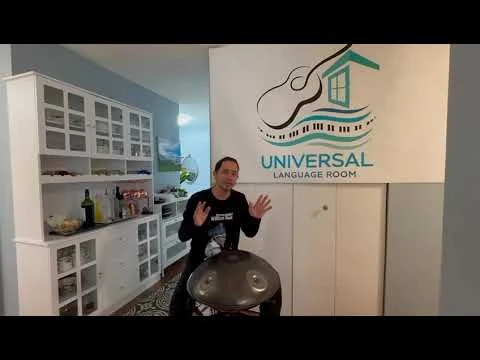
Xylophones, handpan, voice, tabla, harmonium, guitar, drums, and other instruments can carry the framework. The instrument is a doorway; listening is the practice.
William Ruiz’s handpan work demonstrates how a small pitch set can still feel spacious, expressive, and welcoming.
The framework is inspired in part by Abraham Abulafia’s exploration of letters, breath, focused attention, and permutation—the insight that a small set of elements can generate vast possibilities.
ULR draws inspiration from Abulafia’s use of permutation, not from religious ritual. No particular faith, belief, or spiritual practice is required to participate.
Read the historical and scholarly context →The original facilitator concepts: pitch permutations, melodic storytelling, ensemble practice, and group reflection.